
REVIEW · ROME
Rome by night on Vespa
Rome feels different from the back of a Vespa. In three hours, you can move from the Colosseum to Trastevere, cross the Tiber, and reach hilltop viewpoints that would take much longer on foot. The city’s old stones, fading light, and evening streets make this a fine way to catch La Dolce Vita without spending the night in a tour bus.
I like the private-group format, which keeps the outing personal, and I like the chance to cover far more ground than you could walking. Mario has received particular praise for his French and for offering useful, less-touristy Rome tips. The main consideration is simple: you are riding through city streets at night, so this suits you best if you feel comfortable on a Vespa and want movement rather than a slow, detailed walk.
Key points at a glance
- Rome after dark: See major monuments under evening lights, when the city takes on a more romantic mood.
- Vespa sightseeing: Travel between the Colosseum, Trevi Fountain, Pantheon, Spanish Steps, and Trastevere without tiring your feet.
- Local driving pilot: A pilot drives the Vespa, so you can focus on the views and listen to commentary.
- Private three-hour outing: Your group has its own experience rather than joining a large shared tour.
- Hilltop panoramas: Look for broad views over Rome and unusual angles shaped by the city’s hills and old streets.
- Four guide languages: Tours are available in English, French, Italian, and Spanish.
Why Rome by Vespa works best at night
Rome is not a tidy museum arranged in a straight line. Ancient ruins sit beside Renaissance façades, medieval lanes lead toward grand squares, and the Tiber divides the city before bringing its neighborhoods back together by bridge.
A Vespa helps you make sense of that sprawl. You do not simply visit one monument and then walk to the next. You see how the parts connect: central Rome, the Colosseum area, the Spanish Steps, the river, and Trastevere. In three hours, you get a moving introduction to the city rather than a close study of one site.
The timing also changes what you notice. Evening light softens the stone buildings, highlights fountains and domes, and gives the streets a more intimate feel. You may find the monuments easier to appreciate from outside at night, when the focus is on their shape, setting, and atmosphere rather than on entering every major attraction.
This is not a replacement for a Colosseum tour or a guided walk inside the Pantheon. It is a way to connect many of Rome’s famous sights in one outing and see how the city looks after the heat and noise of the day have eased.
More Vespa Night Tours in Italy
- Vespa Sidecar Tour By Night with Pickup
★ 5.0 · 1,803 reviews - Vespa Sidecar Tour at Day/Night with Pickup
★ 5.0 · 217 reviews - Rome: Evening Vespa Sidecar City Tour
★ 4.9 · 104 reviews
Starting at Vicolo di San Nicola de Cesarini
The tour begins and ends at Vicolo di S. Nicola de’ Cesarini, 4. Since you return to the same point, you do not need to arrange a second meeting place at the end of the evening.
That central starting location makes the outing useful as an early or middle part of a Rome visit. You can use the ride to get your bearings, then return to the center for dinner or continue exploring on foot. Hotel drop-off is not included unless your hotel is very central, so plan your return from the meeting point before you book.
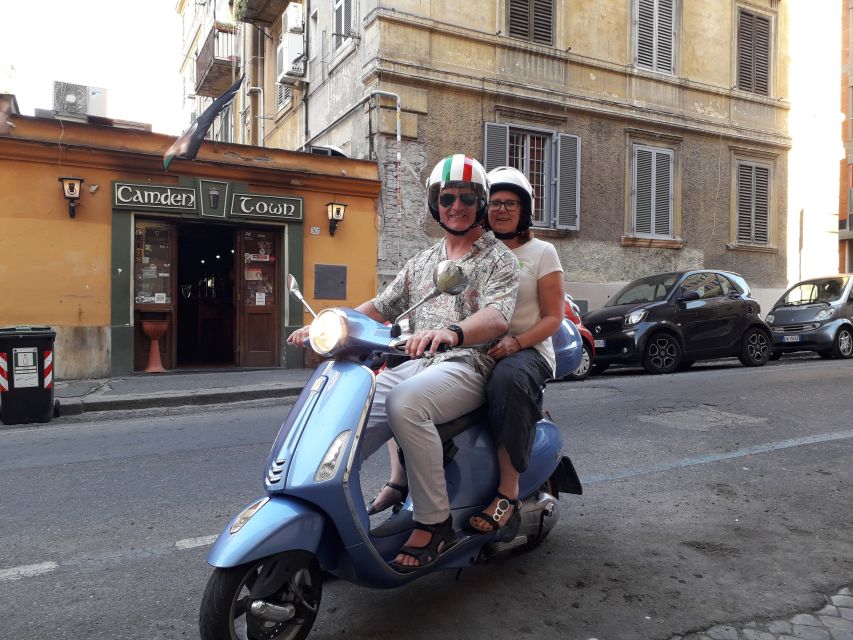
At the start, you receive a helmet and basic insurance, and a driving pilot handles the Vespa. This matters because you can watch the city instead of worrying about navigation. It also makes the tour different from a self-drive rental, where traffic, directions, and parking would become part of your evening.
The information provided does not specify the exact Vespa setup for every booking, so confirm any seating or vehicle questions before paying if that detail matters to you. The tour is listed as a private group, which should give your party a more focused ride.
The Colosseum and the ancient city after dark
The Colosseum is one of the natural anchors of the route. At night, its arches read as a bold outline rather than as a site you need to examine room by room. A Vespa gives you the advantage of seeing the monument as part of the wider city.
This section is especially useful if you are short on time. You can include the Colosseum in a broad evening circuit, then return later for a dedicated daytime visit if you want to go inside. Keep your expectations clear: the tour takes you through Rome’s streets and viewpoints, but entry tickets to monuments are not part of the experience.
The route also connects ancient Rome with later periods of the city. That mix is one of the most interesting parts of the ride. You are not seeing a single era preserved behind ropes. You are moving through a city where old ruins, churches, palaces, fountains, and modern traffic share the same space.
Piazza Venezia and the changing face of Rome
Piazza Venezia offers another useful city view. It is a major central reference point, and passing through it helps you understand how Rome’s grand avenues link the old center with other districts.
From a Vespa, you can take in the scale of the square without committing to a long stop. That is the value of this tour style: the ride keeps the evening moving while still giving you a series of visual landmarks.
The tradeoff is that a moving tour gives you less time for close inspection. If you want to study architectural details, read inscriptions, or take many photographs, you may need to return independently. I would treat Piazza Venezia as part of the larger picture rather than as a full sightseeing stop.
More Vespa Night Tours in Rome
- Rome by Night Vespa Tour With Driver/Private Guide
★ 4.9 · 72 reviews - Fiat500 Night&Day Photoshoot, with a Roman, pickup included
★ 5.0 · 59 reviews - Rome: Night Photo Session in a Fiat 500 with Aperol Spritz
★ 4.7 · 54 reviews - Vespa Scooter Night Tour in Rome with Professional Photographer
★ 5.0 · 46 reviews
The Pantheon, Piazza Navona, and Rome’s grand center
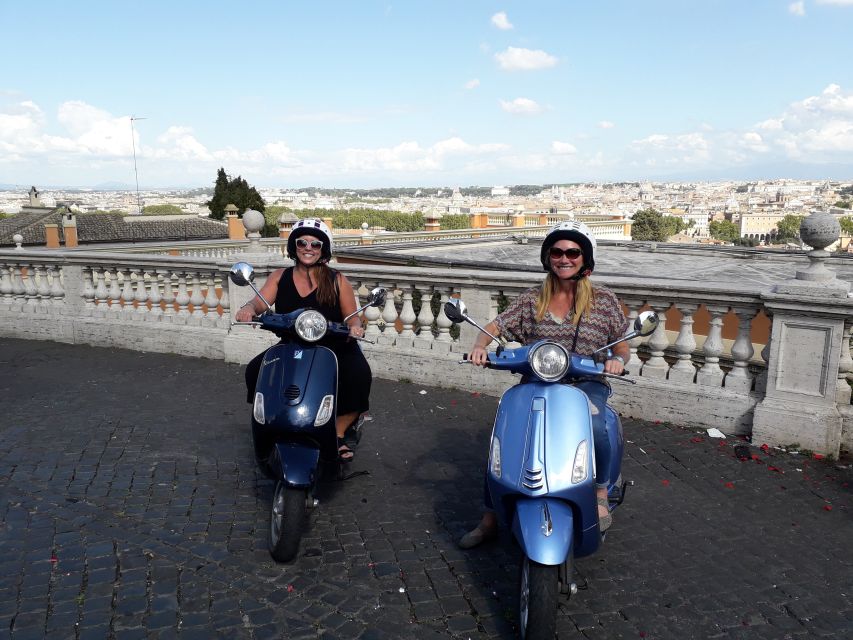
The Pantheon and Piazza Navona bring the route into the heart of Rome’s historic center. These are places where the city’s layers are easy to read. Ancient foundations, medieval changes, Renaissance planning, and later public life all meet within a compact area.
Piazza Navona is known for its broad open shape and grand fountains. The Pantheon has a different mood, with its powerful round form and ancient structure. Seeing both in the same evening helps you compare two very different expressions of Roman architecture.
You may find that the nighttime setting makes these stops more atmospheric than informative. The fading light can make the façades and fountains memorable, but the route is not presented as a long lecture at each site. If you prefer continuous historical explanation, ask how much commentary your guide usually provides before setting off.
The multilingual guide option is useful here. English, French, Italian, and Spanish are available, and Mario has been specifically praised for speaking French well and for sharing tips that help you see Rome in a less standard way. If French is important to you, request or confirm Mario when booking, since guide assignment may depend on availability.
Trevi Fountain and the Spanish Steps
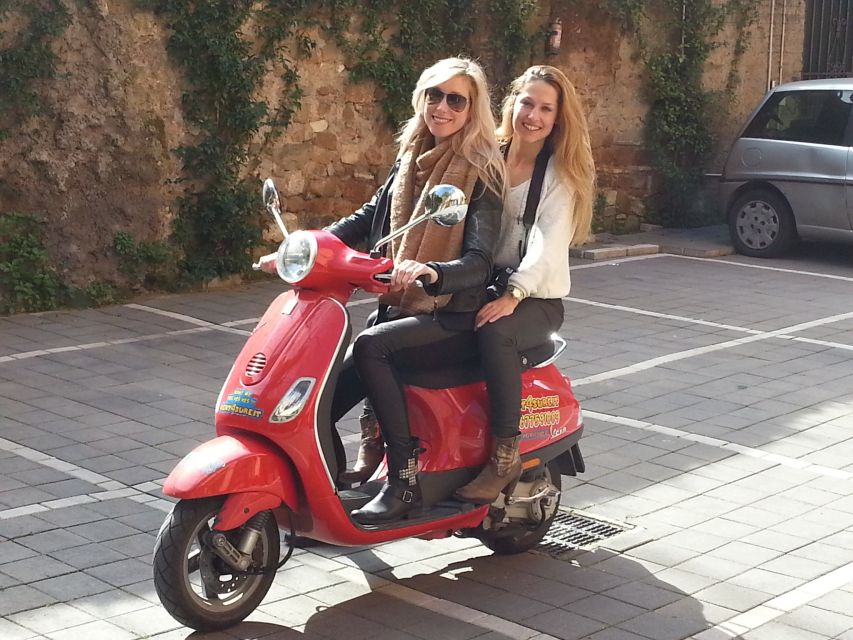
Trevi Fountain and the Spanish Steps are two of Rome’s most familiar sights, but they work well in an evening route because their surroundings are part of the appeal. The ride lets you connect them without making you walk the full distance between busy central streets.
At Trevi, the focus is the fountain’s theatrical setting and the way light catches the water and stone. At the Spanish Steps, the point is the urban setting around the staircase, with streets and buildings gathering around a famous public space.
These locations can be crowded, even after sunset. A Vespa tour cannot guarantee a quiet visit, and it will not give you a private viewing area. Still, the ride can save your legs and help you fit both sights into a single evening.
I would bring a small phone or camera that is easy to handle, but keep your attention on the group and the guide. You may have only a short time at each place, so it is better to enjoy the view than turn every stop into a photography session.
Caracalla and the wider sweep of Rome
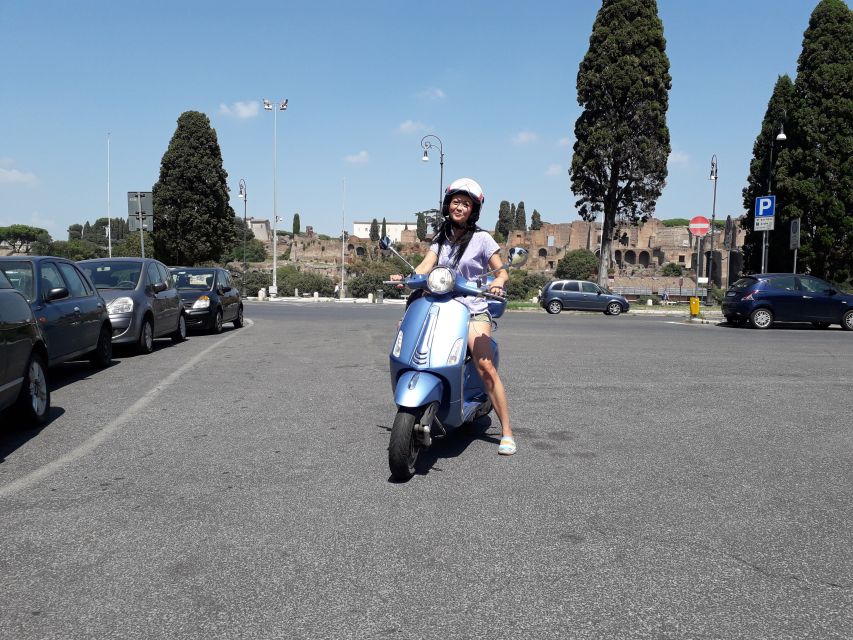
The Baths of Caracalla add an important ancient site beyond the Colosseum. Even when you see them from the outside or pass through the surrounding area, they broaden your picture of Roman public life and the scale of the ancient city.
This part of the route helps explain why riding is useful. Rome’s monuments are spread across a large area, and walking between the central sights and the ancient southern district would take time. A Vespa lets you experience the distance itself, not just a series of isolated points.
The supplied details do not promise entry to the Baths of Caracalla, so plan on an exterior or drive-by view unless your guide tells you otherwise. The same rule applies to the other named monuments: this is a sightseeing ride, not an admission package.
Crossing the Tiber into Trastevere
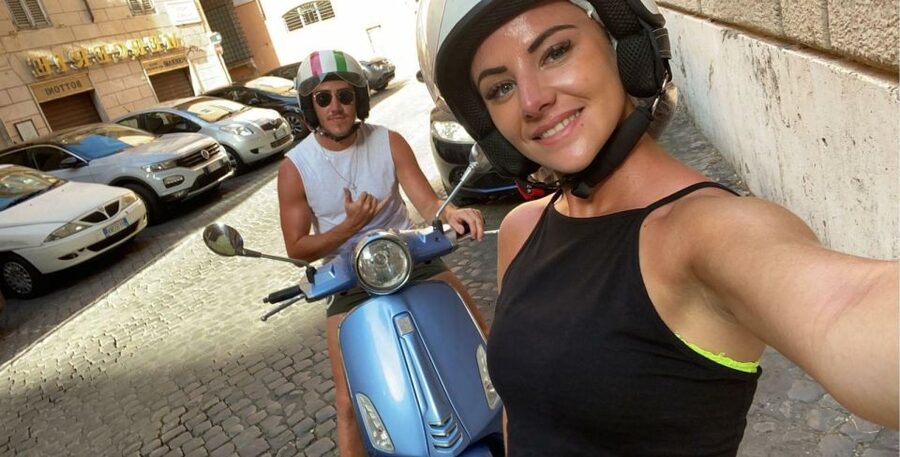
Crossing the Tiber is one of the most enjoyable ideas built into the route. The river gives Rome a natural divide, and moving from one bank to the other shows how the city’s neighborhoods change.
Trastevere is known for its narrow streets and evening character. The tour gives you a taste of that district without requiring you to spend the whole night there. You can return later for a meal or a longer walk if the neighborhood catches your interest.
This is also where the local guide can add real value. Mario’s useful, less-touristy tips are the kind of information that can shape the rest of your stay. Ask about places to eat or areas worth walking after the tour, though food and drinks are not included.
Because the tour remains on the move, you should not expect a long neighborhood orientation. Think of Trastevere as a change of mood and setting, with enough time to notice its character and decide if you want to come back.
Hill views, optical tricks, and evening light
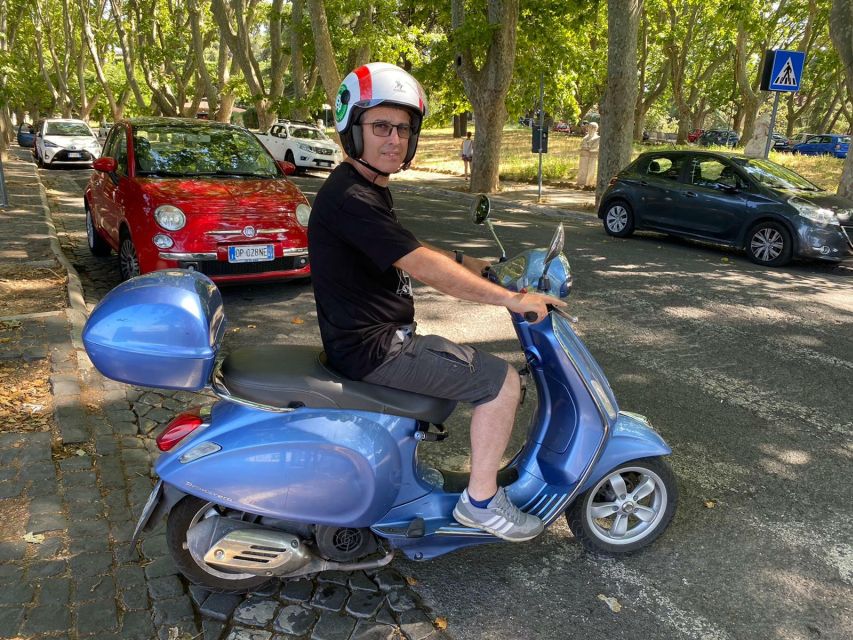
The ride includes panoramic views from Rome’s hills and points where architecture creates unusual perspectives. These details give the tour more personality than a simple circuit of famous monuments.
Rome often rewards you for looking along a street, through an arch, or across a river rather than directly at a single building. The route is designed to show those relationships, including optical effects created by architects over the centuries. The exact viewpoints are not specified, so the experience may vary with the guide and the evening route.
These views are one reason to choose the Vespa over a standard walking tour. You can reach higher points and move between them with less effort. The drawback is that traffic and timing can affect how long you stay at any one panorama.
Night lighting also changes the quality of photographs. You may get attractive silhouettes and reflections, but low light can make casual phone photos difficult. I would enjoy the views first and treat photography as a bonus.
What the $157.92 price includes
At $157.92 per person, this is not the cheapest way to see Rome’s monuments. The price makes more sense if you value a private group, a three-hour route, a driving pilot, helmets, basic insurance, and the ability to cover many neighborhoods in one evening.
It is less compelling if you mainly want detailed historical interpretation at each site or admission to the monuments. Food, drinks, and hotel drop-off are not included, and no entry tickets are listed. You are paying for mobility, local guidance, and a special way to see Rome, not a bundle of attraction admissions.
For two people or a small private party, the value depends on how much you would otherwise spend on separate transport and sightseeing. The convenience of moving directly from one area to another can be worthwhile, especially during a short stay.
The experience also has a flexibility advantage. You can reserve now and pay later, and cancellation is allowed up to 24 hours in advance for a full refund. Starting times vary, so check availability and choose an evening slot that leaves room for dinner or another plan.
Who should book this Vespa tour?
I would recommend it to you if you want a broad first look at Rome, enjoy unusual city transport, and prefer seeing many famous places from outside rather than spending hours inside one attraction.
It is particularly well suited to:
- Couples seeking a romantic evening ride
- First-time visitors who want a quick sense of Rome’s layout
- Repeat visitors looking for a different view of familiar monuments
- Small groups that value a private outing
- People who would find a long walking tour tiring
- French, English, Italian, or Spanish speakers who want a guide in one of those languages
I would think twice if you dislike motor traffic, feel uneasy riding through city streets, or want a slow tour with long stops. The tour does not provide food, drinks, or a central hotel return unless your hotel qualifies as very central.
Should you book Rome by night on Vespa?
Book it if the idea of seeing Rome in motion appeals to you. The combination of major monuments, hill panoramas, Tiber crossings, and Trastevere gives you a broad evening portrait that is difficult to copy on foot in only three hours.
The strongest reasons to choose it are the private setting, the local driving pilot, and the chance to see the city after dark. Mario’s French and practical tips are an added reason to ask about guide availability if you speak French.
Skip it if your main goal is interior access, detailed site-by-site history, or a quiet walk. For the right kind of visitor, though, this is a lively and efficient way to feel Rome’s scale and catch its evening mood without exhausting your feet.
FAQ
How long does the Rome by night Vespa tour last?
The tour lasts three hours.
Where does the tour begin?
It begins at Vicolo di S. Nicola de’ Cesarini, 4.
Where does the tour end?
The tour returns to Vicolo di S. Nicola de’ Cesarini, 4.
Which sights are included in the route?
The route includes the Colosseum, Piazza Navona, the Pantheon, Piazza Venezia, Caracalla, the Spanish Steps, Trevi Fountain, and Trastevere.
Is the tour private?
Yes. The tour is offered as a private group experience.
Which languages are available?
The live guide is available in English, French, Italian, and Spanish.
Is a Vespa provided?
Yes. The tour includes Vespa rental, helmets, basic insurance, and a driving pilot.
Are food, drinks, and hotel drop-off included?
No. Food and drinks are not included. Hotel drop-off is also not included unless the hotel is very central.
Just added around Rome
- Vespa Tour with Professional Photographer★ 4.9 · 9 reviews
- Rome: Vespa Tour with Gelato and Photos★ 4.9 · 7 reviews
- Vespa tour with Professional Photoshoot★ 4.8 · 22 reviews
- Vespa Sidecar Tour: Highlights of Rome★ 4.7 · 10 reviews
- Food tour & Vespa tour & Photo tour! All included★ 5.0 · 2 reviews
- Vespa Tour – Explore Ancient Rome★ 5.0 · 5 reviews
- Vespa Sidecar Tour : Rome by Night★ 4.1 · 7 reviews
- Vespa Scooter Tour “Rome as a Local”★ 5.0 · 12 reviews
Rome Vespa Tours, compared.

Rome Morning Vespa Sidecar Tour in Rome with Cappuccino
Read our review →
Explore the City by Vespa with an Optional Photoshoot
Read our review →
Rome Vespa Scooter Tour with Professional Photographer
Read our review →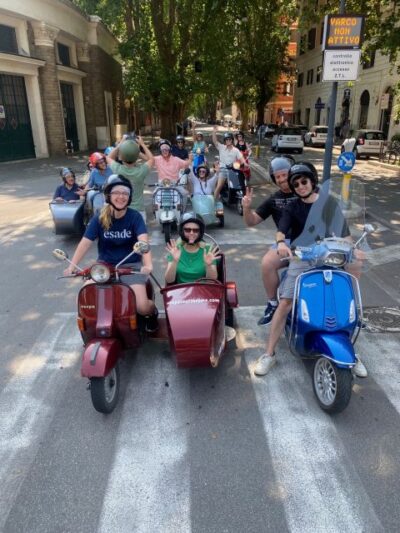
Highlights Vespa Sidecar Tour with Coffee and Gelato
Read our review →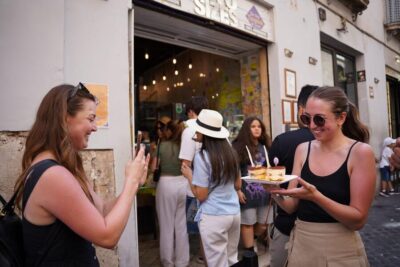
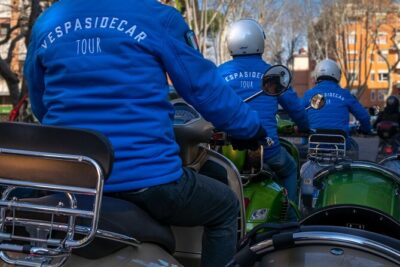
Rome Afternoon Sightseeing Vespa Sidecar Tour with Gourmet Gelato
Read our review →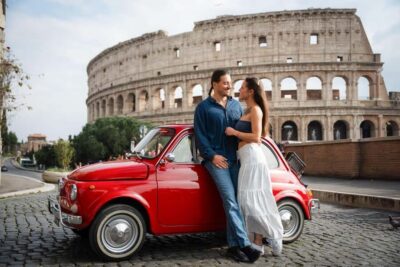
Browse the lists this tour appears in