
REVIEW · PORTUGAL
Megalithic & Medieval Tour of Monsaraz in a Moto Sidecar
Monsaraz is more than a pretty medieval hilltop village. This three-hour moto sidecar tour links ancient burial stones, a cromlech, a menhir, Templar defenses, Jewish history, churches, and pottery villages in one compact outing. Guide Paulo leads in English, Portuguese, or Spanish.
I like the way the tour connects the Alentejo countryside with the long human story of the area. I also like the private format: you get a focused guide rather than a large group trailing through the village. The main drawback is the weather rule. The route is canceled if it rains or snows, and lunch is not included.
Key points
- A rare sidecar view of Monsaraz: Travel by motorcycle sidecar between the village, megalithic sites, and S. Pedro do Corval.
- Three major prehistoric stops: See Anta Olival da Pêga, Xarez Cromlech, and the Abelhoa menhir.
- History from Castros to the Inquisition: The route covers Castros, Romans, Muslims, Templars, Jewish heritage, and later religious buildings.
- A strong guide-led experience: Paulo is praised for detailed explanations, clear answers, friendliness, and professionalism.
- A private three-hour outing: The tour begins and ends in Monsaraz, with live guiding in English, Portuguese, or Spanish.
- Pottery to finish: The last stop is S. Pedro do Corval, known here for its pottery tradition.
Why the sidecar makes sense in the Alentejo
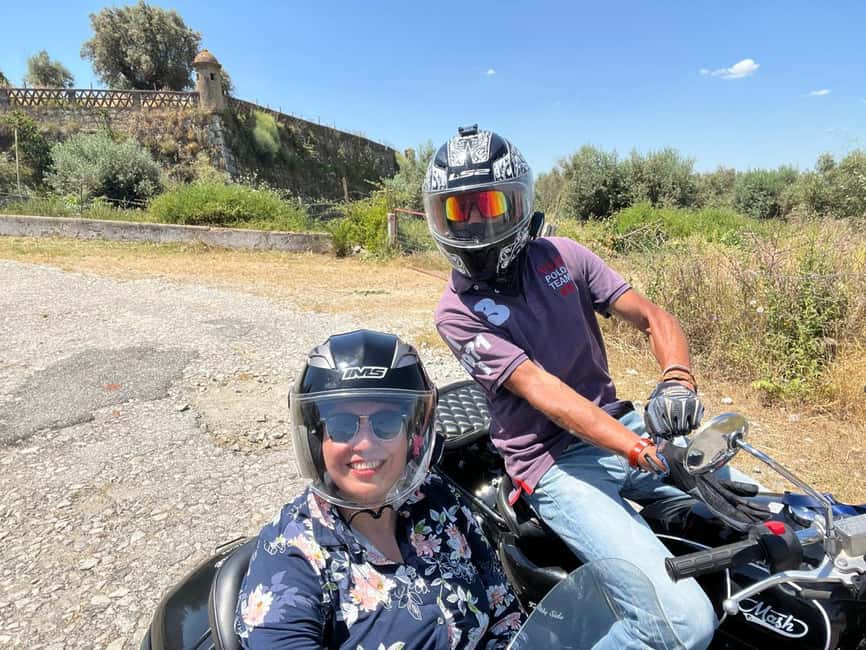
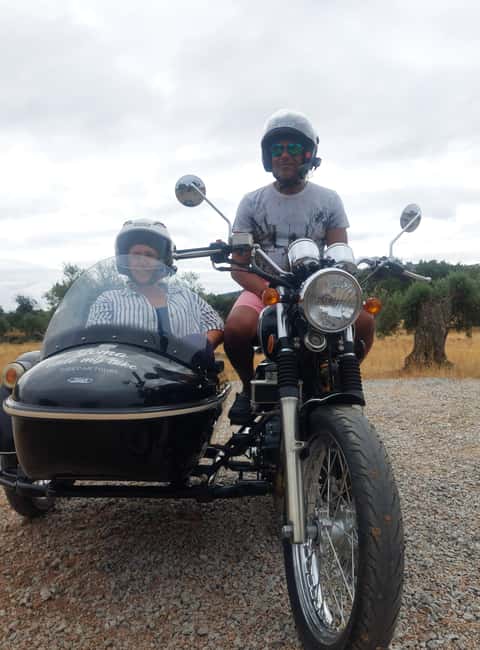
The sidecar is not just a novelty here. It gives the tour a clear shape: you leave Monsaraz, cross the open Alentejo plains, visit sites that are spread around the area, and return to the medieval village without arranging separate transport.
You will pass cork oak trees and vineyards along the way. That matters because Monsaraz is not only a walled settlement. Its setting is part of the experience, and the sidecar lets you see the countryside between each historical stop rather than treating the village as an isolated monument.
The price is listed as $47 per group of up to one person. Read that wording carefully when booking, since the published capacity is one. For a three-hour private outing with transport, a guide, and several separate sites, the price can be good value for a solo visitor. It is less useful to compare it with a simple walking tour, since this experience covers ground outside Monsaraz and includes the ride itself.
Everything is included except lunch. That keeps the tour simple, but you should plan your meal separately. The schedule is built around sightseeing, not a long restaurant stop.
More Vespa Sidecar Tours in Portugal
- Private Tour: Best of Lisbon by Sidecar
★ 5.0 · 377 reviews - Madeira Sidecar Adventure – Old West Road (1 or 2 Persons)
★ 5.0 · 228 reviews - Lisbon: Sidecar Tour
★ 5.0 · 123 reviews
Starting in Monsaraz and heading into the plains
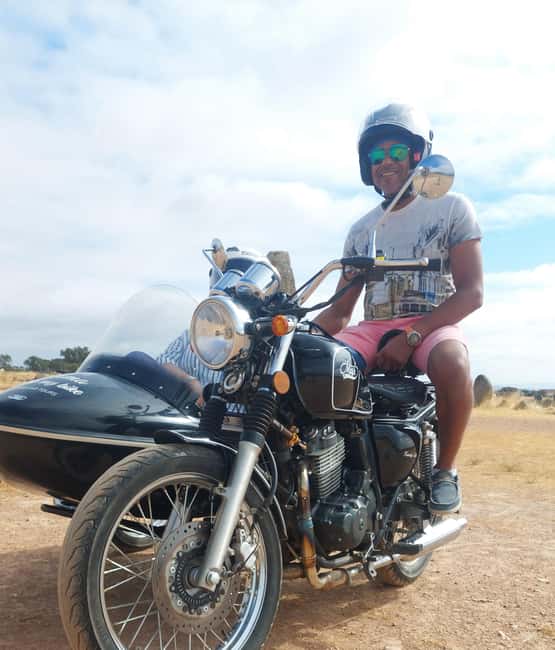
The meeting point is easy to identify: the sidecar motorbike waits in front of the tourist office, on the other side of the road. The tour starts in Monsaraz and returns there after the circuit.
The first part is a ride through the Alentejo countryside. Cork oak trees and vineyards provide the setting, while the guide introduces the area before the stops begin. Since the tour is private, you can ask questions as the route unfolds. That is useful here because the sights range across several periods, and a good explanation helps connect them.
The tour is conducted in English, Portuguese, or Spanish. Guide Paulo is named as the person leading the experience, and the strongest feedback about the tour centers on his approach. He is described as cultured, friendly, professional, and willing to answer questions in detail. One particularly useful point is that the entire route is explained carefully, with the visible sites identified as you go.
That style suits this tour. The stones and walls are worth seeing, but much of their meaning comes from knowing what you are looking at.
Anta Olival da Pêga and the first prehistoric chapter
The first stop is Anta Olival da Pêga, a megalithic tomb. The word anta refers to the type of prehistoric stone burial monument found in Portugal, and this stop sets the tone for the rest of the outing.
The value here is not only the structure itself. It shows that the area’s story begins long before the Castros, Romans, Muslims, or Templars. Starting with a burial monument gives the tour a useful time line, moving from prehistoric communities into later fortified and religious settlements.
Your guide’s role is especially important at this stop. A megalithic monument can look like a group of large stones if nobody explains its purpose and place in local history. The detailed, classroom-like approach praised for Paulo should help you see the site as part of a wider pattern rather than a quick photo stop.
The tour does not list a long walk or a separate archaeological lecture, so expect a guided visit within the three-hour circuit. If you prefer a tour that keeps moving and links several sites, this pace should suit you. If you want extended time for quiet study at one monument, the broad itinerary may feel brisk.
Xarez Cromlech and the Abelhoa menhir
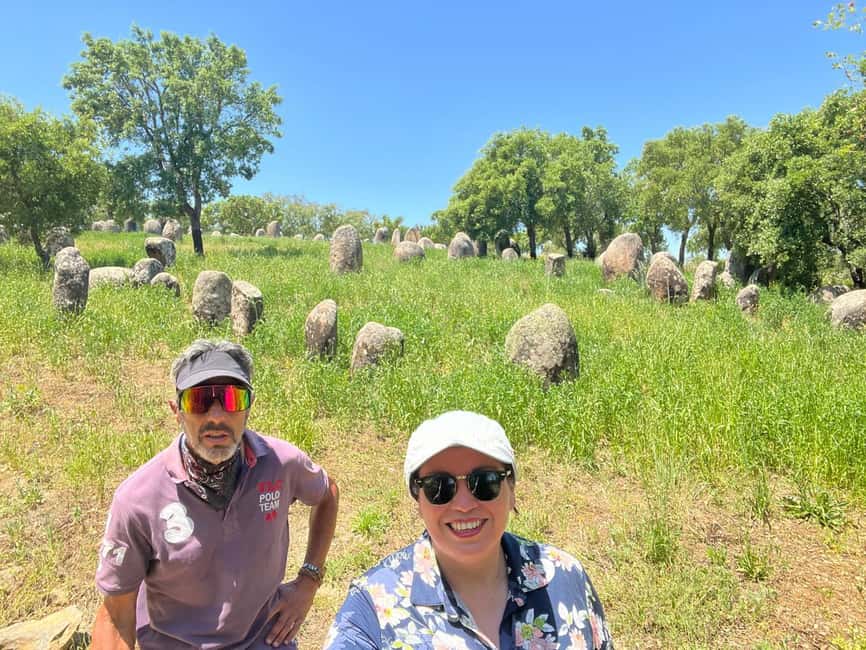
Next come the Xarez Cromlech and the Abelhoa menhir. These are two different forms of prehistoric stone monument, which makes the sequence more interesting than visiting several similar sites.
A cromlech is an arrangement of standing stones, while a menhir is a single upright stone. The Xarez site gives you a sense of stones arranged in relation to one another. The Abelhoa menhir puts the focus on one prominent vertical marker. Together with Anta Olival da Pêga, they create a compact introduction to megalithic heritage.
These stops also show why transport matters. The tour is not confined to Monsaraz’s streets. You are using the sidecar to connect a tomb, a stone circle, and a standing stone before turning to the later village and its defenses.
I would pay close attention to Paulo’s explanations here. The itinerary covers a large sweep of time, and the guide’s detailed commentary is one of the main reasons to choose this experience over simply locating the stones on your own. The tour’s strongest praise is directed at the depth of the explanations and the way questions are handled.
Same roads, a different ride:
- Highlights of Porto on a glamorous sidecar – Half Day
★ 5.0 · 108 reviews - Vespa Primavera 24 Hour Rental in Madeira
★ 5.0 · 65 reviews - Madeira Island: 3-Hour Old Road Tour by Sidecar
★ 5.0 · 60 reviews - Half-Day Private Sidecar Tour on Madeira’s West Coast
★ 5.0 · 41 reviews
Monsaraz Castle, the Tower of Homage, and the barbican
The medieval portion brings you back to Monsaraz, where the castle, Tower of Homage, and barbican form the central defensive story.
The castle gives you the clearest view of Monsaraz as a fortified settlement. The Tower of Homage adds a strong vertical marker, while the barbican shows how defense extended beyond the main walls. The tour presents these features as part of a legacy shaped by Castros, Romans, Muslims, and Templars.
That sequence is useful because it avoids treating the medieval village as a single-period attraction. The walls and towers belong to the visible medieval chapter, but the site carries traces of earlier powers and communities. A guided explanation can help you keep those layers separate.
You should expect a walking component once the tour reaches the village. The experience is described as a guided tour of Monsaraz, not only a motorcycle ride past the sights. Wear practical shoes, since medieval streets and fortified areas are best approached at an easy pace, though the supplied information does not specify the exact surface or distance.
The private format is a plus here. You can ask why a tower, wall, or defensive feature mattered without worrying about holding up a large group.
Hermitages, churches, and the quieter corners of the village
The route continues beyond the main castle sights. It includes the Santa Catarina Hermitage, the 17th-century fortification, the ruins of the Fortress of S. Bento and its hermitage, the Fork, the former Hermitage of S. Lázaro, and the Church of Nossa Senhora da Lagoa.
This is where the tour moves from headline monuments to smaller pieces of Monsaraz’s built story. Hermitages can be easy to skip when you are focused on a castle, yet they help show how religious life shaped the settlement. The churches add another layer, with the Church of Nossa Senhora da Lagoa among the named stops.
The 17th-century fortification and the ruins of S. Bento are useful reminders that defense did not end with the first medieval walls. The route brings together active-looking structures, older religious buildings, and ruins. That contrast gives the village more character than a simple castle visit.
The stop called the Fork is included in the route, though no further detail is provided about it. Your guide will be the person to explain its place in the tour. This is a good example of why the live guide matters: not every named site will explain itself.
Town hall, Santiago, and the house of the Inquisition

The civic and religious story continues with the town hall, the Church of Santiago, and the house of the Inquisition.
The town hall represents local government, while Santiago adds another church to the route. The house of the Inquisition brings a darker and more complicated chapter into the tour. The listed highlights also include Jewish heritage, so this section is not limited to monuments and architecture. It points toward the people and institutions that shaped life in the village, including the pressure placed on religious minorities.
I appreciate that the route includes this subject instead of presenting Monsaraz as a polished medieval picture with no difficult history. The Inquisition and Jewish heritage require careful explanation, and this is another area where Paulo’s detailed, question-friendly style should add real value.
The tour does not promise entry into every building, so you should understand the experience as a guided circuit of named places and historic features. The exact access inside each site is not specified. Even so, the range of stops gives you a fuller view of Monsaraz than a quick walk around the castle alone.
S. Pedro do Corval and a pottery finish
The final stop is S. Pedro do Corval and its pottery. This changes the rhythm of the tour in a welcome way. After prehistoric monuments, fortifications, churches, and the Inquisition, you finish with a living craft tradition.
Pottery gives the route a present-day connection. You are not only looking backward at stones and ruins. You are also seeing a local activity that remains part of the area’s identity. The information provided does not specify whether a workshop demonstration or purchase is included, so do not assume either. The stop is described as a visit connected with pottery.
Ending here also makes practical sense. The tour has already covered the main historical range, and the pottery stop provides a less solemn final note before returning to Monsaraz.
What the three hours feel like
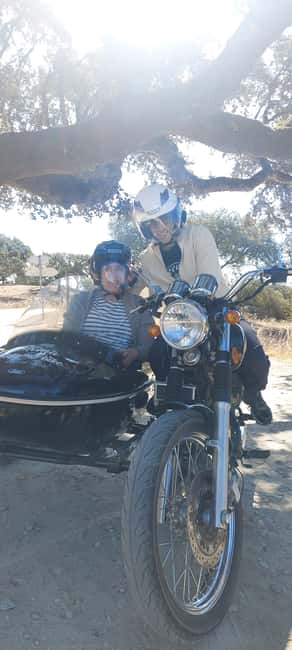
Three hours is long enough to create a real story but short enough to fit into a day of sightseeing around Monsaraz. The route includes countryside riding, three megalithic sites, a substantial medieval village circuit, and S. Pedro do Corval. That is an ambitious amount for one outing.
The best way to approach it is as a broad introduction. You will see many places and hear how they connect, but you should not expect a slow archaeological field study at every stop. The detailed commentary helps make the schedule work.
The feedback about the timing is especially useful. The tour has been described as so engaging that the three hours pass quickly. That points to a good balance between movement and explanation, though your own pace will depend on questions, weather, and how long each stop takes.
The route is canceled if it rains or snows. This is important in a sidecar, where weather has a direct effect on comfort and safety. Check the forecast before you set out, and keep your plans flexible.
People over 95 are listed as unsuitable for the activity. Alcohol and drugs are not allowed. No other restrictions are provided, so you should rely on the booking information for any personal mobility or seating questions that matter to you.
Who should book this Monsaraz tour?
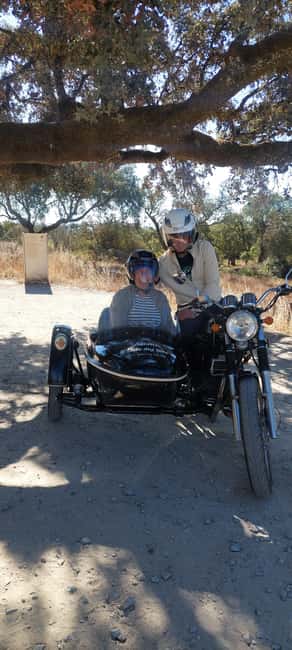
I would choose this tour if you want more than a standard village walk. It suits you especially well if you like archaeology, medieval defenses, religious buildings, local crafts, and a guide who explains the links between them.
It is also a smart option for a solo visitor who wants private guiding and transport beyond the village. The published $47 price for a group of up to one person makes the value strongest when you want a personal experience rather than a large shared tour.
You may want to skip it if you need a guaranteed indoor program, since the route is canceled in rain or snow. It may also be a poor match if lunch must be built into your excursion, because lunch is not included.
The tour has earned a top rating from three verified bookings, with the most consistent praise focused on Paulo’s detailed history lessons, his friendliness, and his professional manner. Those comments point to the experience’s real strength: not simply seeing many places, but understanding what you are seeing.
FAQ
Where does the tour start?
It starts in Monsaraz. The sidecar motorbike is in front of the tourist office, on the other side of the road.
Where does the tour finish?
The tour returns to Monsaraz after visiting S. Pedro do Corval and its pottery.
How long does the tour last?
The guided tour lasts three hours.
What languages are available?
The live guide conducts the tour in English, Portuguese, or Spanish.
Is the tour private?
Yes. It is offered as a private group experience, with the listed price covering a group of up to one person.
Is lunch included?
No. Lunch is not included in the tour price.
What happens if it rains or snows?
The route is canceled if it rains or snows. You can cancel up to 24 hours in advance for a full refund, and the booking option allows you to reserve now and pay later.
Should you book it?
Book this tour if you want Monsaraz explained in layers, from prehistoric stones to Templar defenses, Jewish history, the Inquisition, churches, and pottery. The sidecar adds a practical way to connect the scattered sites, while Paulo’s detailed guiding appears to be the main reason the experience works so well.
Skip it only if bad weather is likely, you need lunch included, or you prefer a slow visit focused on one monument. For a curious solo visitor with three hours to spare, this is an unusually broad and personal way to meet Monsaraz.
Just added around Portugal
- Private Tour of Piaggio Ape Calesino★ 5.0 · 2 reviews
- Lisbon – Private Vintage Sidecar Tour to Sesimbra’s Coast★ 5.0 · 13 reviews
- Private Sidecar Sunset & Drinks!★ 5.0 · 16 reviews
- Lisbon by Fiat 500 Jolly convertible!!★ 5.0 · 4 reviews
- Lisbon: Private Experience Motorcycle Sidecar Tour★ 5.0 · 14 reviews
- Private Vespa West Tour-Seixal,São Vicente,Porto Moniz(4hr)★ 5.0 · 4 reviews
- Private Vespa Tour Nun´s Valley,Câmara Lobos,CaboGirão(4hrs)★ 5.0 · 6 reviews
- Porto Private Sidecar Tour★ 5.0 · 18 reviews
Portugal Vespa Tours, compared.
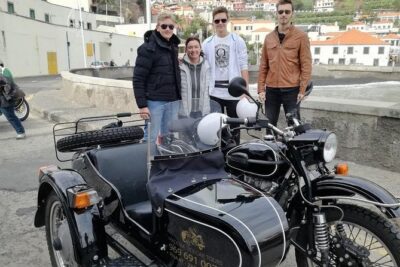
Madeira Sidecar Adventure – Old West Road (1 or 2 Persons)
Read our review →

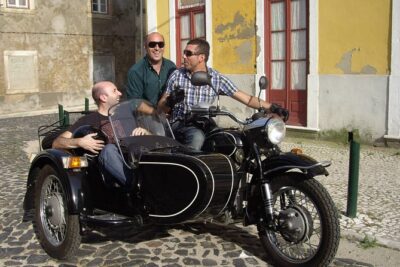
Highlights of Porto on a glamorous sidecar – Half Day
Read our review →


Browse the lists this tour appears in