
REVIEW · LISBON
Lisbon El Cristo-Rei – Private Vintage Sidecar Tour
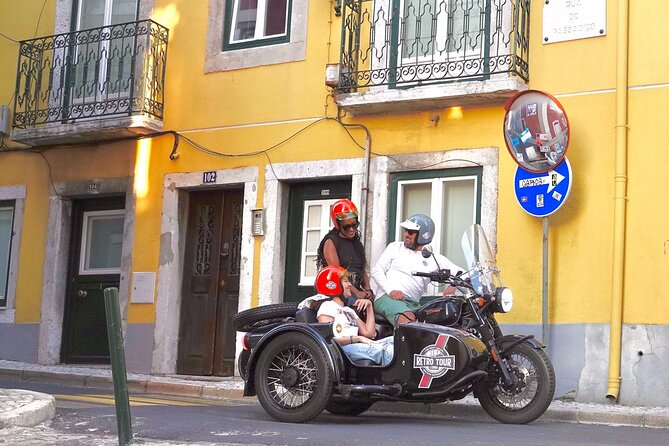
Lisbon is at its most fun when you leave the tour bus behind. This private vintage sidecar ride crosses the Tagus to the Cristo Rei statue, then returns you to the city by way of viewpoints, old quarters, art, and stories about Portugal’s dictatorship and earthquake. You get a moving view of Lisbon without being sealed behind glass.
I especially like the chance to cross the river quickly and reach Cristo Rei, an outing that is awkward to fit into a short city visit on foot. I also like the relaxed format: Stéphane and Frédéric can adjust photo stops and points of interest, while the comfortable new motorcycles include phone chargers.
The catch is the price: $360.23 for up to two people is a serious spend for two hours. The ride also depends on good weather, and the open sidecar gives you fresh air, but not much shelter from wind or rain.
Key points at a glance
- A private ride for two: Your group has the sidecar and guide to itself, with no fixed large-group pace.
- Cristo Rei across the Tagus: The tour reaches the foot of Lisbon’s famous Christ statue by crossing the river.
- More than a photo ride: Stops cover Portuguese archaeology, the 1755 earthquake, the 1974 end of dictatorship, art, and Lisbon’s water supply.
- A comfortable vintage setup: Helmets, gloves, goggles, new motorcycles, and phone chargers are included.
- Flexible sightseeing: You can ask to adjust the route or pause for photographs.
- A short but packed outing: In roughly two hours, you see both central Lisbon and the south bank.
Why the sidecar changes the Lisbon experience
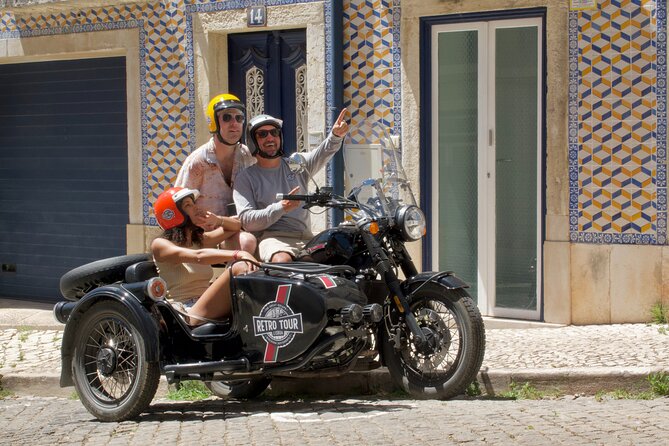
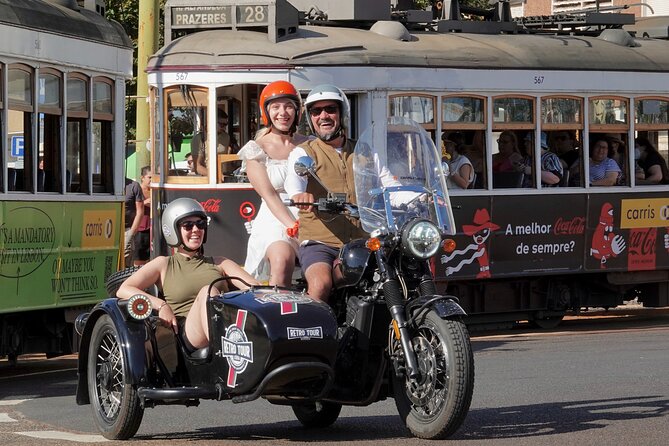
A sidecar gives you a different view of Lisbon from the usual tram, tuk-tuk, or sightseeing bus. You sit close to the street, hear the city, and can speak with the guide while moving. At the same time, you avoid the effort of walking every hill and the delays that come with a larger vehicle.
This is a private tour, so the guide can respond to your interests. If you want more photos, a closer look at a particular sight, or a little less time at one stop, the route has room to bend. That matters in Lisbon, where a short distance on the map can mean a steep climb, a crowded lane, or a slow traffic crawl.
The ride is designed for two people, though the price is charged per group rather than per seat. For a couple, friends, or a parent traveling with one companion, that makes the experience feel personal. For one person, the same group price is harder to justify.
The supplied equipment is practical rather than decorative. You receive a helmet, gloves, and goggles, and the motorcycles are described as new and well equipped. A phone charger is also available, a small detail that helps if you are using your phone for photos or navigation during a full day in Lisbon.
More Private Vespa Tours in Portugal
- Private Tour: Best of Lisbon by Sidecar
★ 5.0 · 377 reviews - Half-Day Private Sidecar Tour on Madeira’s West Coast
★ 5.0 · 41 reviews - Private Sidecar Tour – Downtown Funchal for 1 or 2 People
★ 5.0 · 30 reviews
Starting near Rua Garrett and moving through old Lisbon
The meeting point is R. Garrett 88, in central Lisbon, with the ride ending at Praça do Comércio or another central Lisbon drop-off. That is useful if you are staying in the center and want to continue sightseeing or find lunch immediately afterward.
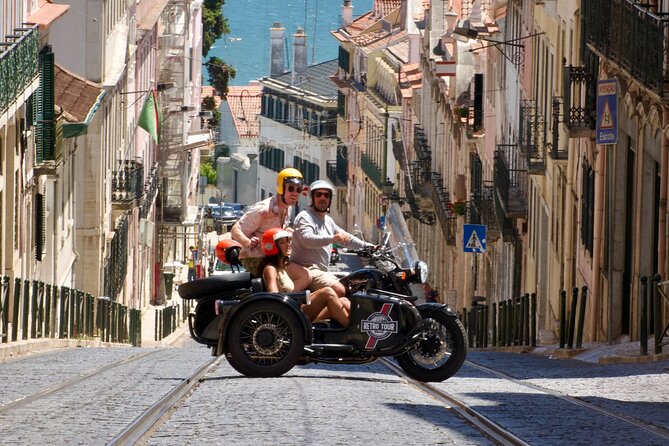
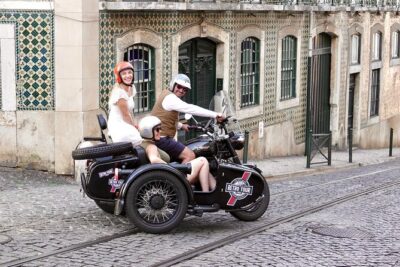
The route includes Rua da Bica, home to Lisbon’s famous yellow tram. You get about five minutes here, with no admission fee. This is a brief stop, so think of it as a quick look and photo opportunity rather than a long visit or tram ride.
Bica is one of those Lisbon scenes that works best in person. The tram climbing the narrow street gives you the classic postcard image, but the stop is short and the area can be busy. Your guide’s ability to pause and move on matters here. If your main aim is a photograph, five minutes may be enough. If you want to ride the tram or explore the surrounding streets, you will need to return on your own.
The tour also takes in a palace decorated with striking Azulejos, the Visconde do Sacavèm Palace. It is listed as municipal heritage and was built between 1897 and 1900, in just three years. The tilework gives you a look at the decorative side of Portuguese architecture, a useful contrast to the grand religious and political sites elsewhere on the route.
The exact timing at this palace is not specified, so your guide’s commentary and the pace of the day will shape the experience. Do not expect a full museum visit unless the schedule allows it. The value here is the quick architectural stop and the chance to see a less predictable part of Lisbon’s built heritage.
A history stop with archaeology, water, and the 1974 revolution
One of the more unusual sections of the ride brings several layers of Portuguese history together. The stop includes a fourteenth-century church connected with Portugal’s preserved independence, the earthquake, and archaeological work.
The site is also linked to archaeological finds from Portuguese soil and from elsewhere, including Peruvian mummies. It serves as the headquarters of Portuguese archaeologists, which gives the place a broader role than a standard church visit. You are not simply looking at a building. You are getting a compact lesson in how Portugal studies its past.
A fountain at the same area explains Lisbon’s old water system. The aqueduct of Águas Livres, built around 1730, used roughly 58 kilometers of galleries to bring water to the western parts of the city, including areas from Bairro Alto toward Ajuda, Belém, and Amoreiras. That detail helps explain how a growing city handled a basic need before modern plumbing.
The final historical layer is political. This is also the place where the dictatorship ended in 1974. Marcello Caetano, who had replaced António de Oliveira Salazar in 1968, was deposed and later sent to Brazil.
I like this part of the route because it connects ordinary city details with major national events. A church, a fountain, an archaeological collection, and the fall of a regime may sound like separate subjects, but together they give you a quick sense of Lisbon’s long civic story.
The limitation is time. Two hours leaves no room for a slow museum visit at every stop. You are getting selected context and a guided overview, not a full historical tour. If you want extensive archaeology or political history, plan a separate visit.
Crossing the Tagus to the Cristo Rei statue
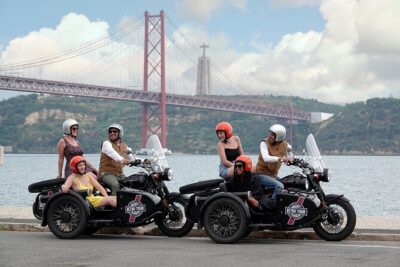
The tour’s main practical advantage is the trip south across the river. You cross the Tagus on the bridge now known as the 25th of April Bridge, then continue to the Sanctuary of Christ the King.
The bridge was built from 1962 to 1966 after the American company US Steel Company, through SF Point Builders, won the tender. Its purpose was to make movement between the two banks of the Tagus easier. It has carried three names: the Bridge over the Tagus, Salazar Bridge, and the 25th of April Bridge.
That name change is not a minor footnote. It links the bridge to Portugal’s dictatorship and the revolution that ended it in 1974. Your guide can connect the physical crossing with the political changes already discussed in Lisbon.
The Cristo Rei stop lasts about 15 minutes, and admission is included. The statue’s story began in the 1930s, when a Portuguese cardinal visited Corcovado in Brazil and liked the idea of a Christ figure protecting Lisbon. The monument took shape from 1949 to 1959, after the Second World War.
The statue gives you a strong view back toward Lisbon and the bridge. The crossing also changes the character of the tour. Instead of staying within the familiar center, you reach the other side of the river quickly and return without arranging a separate train, bus, or taxi.
Fifteen minutes is enough for the main sight and photographs, but it is not a long visit. If you want to spend time inside the sanctuary or linger at the viewpoint, you may find the schedule tight. The attraction here is the efficient access, not an extended religious or architectural study.
The bridge ride may also be a consideration if you dislike open-air motor travel. The sidecar provides a small wind buffer, but it is not an enclosed car. On a cool day, the gloves and goggles help, yet you should dress for moving air.
More Vespa Sidecar Tours in Portugal
- Madeira Sidecar Adventure – Old West Road (1 or 2 Persons)
★ 5.0 · 228 reviews - Lisbon: Sidecar Tour
★ 5.0 · 123 reviews - Highlights of Porto on a glamorous sidecar – Half Day
★ 5.0 · 108 reviews - Madeira Island: 3-Hour Old Road Tour by Sidecar
★ 5.0 · 60 reviews
Coffee and contemporary art at Casa da Cerca
Casa da Cerca, the Contemporary Art Center, is the tour’s pause button. You get about ten minutes for a coffee break, art, and a framed view beneath umbrella pines.
This is a smart stop in a short tour. Sidecar sightseeing is active, and a brief break gives you time to stretch, take in the setting, and talk with your guide. The combination of gallery, coffee, and view also keeps the outing from becoming a nonstop list of monuments.
The setting is one of the main reasons to include it. The view is framed by the pines, giving you a calmer counterpoint to the bridge, traffic, and historic streets. The contemporary art center adds a modern note to a route otherwise focused on older buildings, political history, and religious monuments.
Ten minutes is short, so keep your expectations in line. You are unlikely to explore an entire art center at that pace. The coffee stop is included in the route, but snacks are not included, so bring money if you want food beyond the planned break.
What the $360.23 group price really buys
At $360.23 per group of up to two, this is not a budget sightseeing option. You are paying for a private guide, private transportation, equipment, and a route that crosses the river without requiring you to organize separate transport.
For two people, the price works best when you value privacy and convenience. Split between two, it buys a personal outing with no strangers in your vehicle, plus the ability to request photo stops and adjust the focus. The value is less convincing if you are mainly looking for a cheap way to see Cristo Rei.
The two-hour length is both a strength and a limit. It fits neatly into a busy Lisbon schedule and covers ground that would take longer by foot. You can use it as an orientation ride early in your stay, or as a focused break from museums and walking.
It is not a full-day tour. You will see several important places, but some stops are measured in minutes. I would choose this experience for the transport and access as much as for the individual attractions.
The activity has a five-star rating from 24 ratings, with 100 percent recommending it. That fits the strongest features of the experience: the kind guides, the relaxed mood, the new equipment, and the freedom to stop for photos. Still, satisfaction will depend heavily on your comfort with the price and with riding in an open sidecar.
Comfort, equipment, and the open-air tradeoff
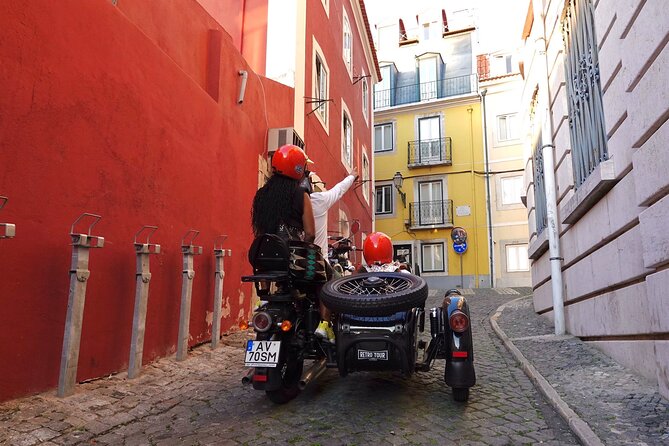
The sidecars are described as comfortable and equipped with phone chargers. Helmets, gloves, and goggles are included, and the motorcycles are new. Those details make a difference because you are not hiring an old motorcycle with unknown equipment and hoping for the best.
You can also speak with the guide while riding, which makes the experience more social than a conventional vehicle tour. Stéphane and Frédéric are the named guides, and the tone is intended to be friendly and unhurried rather than formal.
The open-air design is part of the appeal. You get a cool breeze and a close view of the streets. It is also the main practical drawback. Weather affects the ride, and the operator requires good conditions. If poor weather cancels the tour, you are offered another date or a full refund.
Wear clothing that can handle wind and choose footwear that feels secure. The provided gloves and goggles help, but the tour information does not promise enclosed protection from rain or cold. If you are hoping for a fully sheltered sightseeing vehicle, choose something else.
Most people can participate, and service animals are allowed. The activity is near public transportation, and pickup is offered. Confirmation arrives when you book.
Who should book this private Lisbon ride
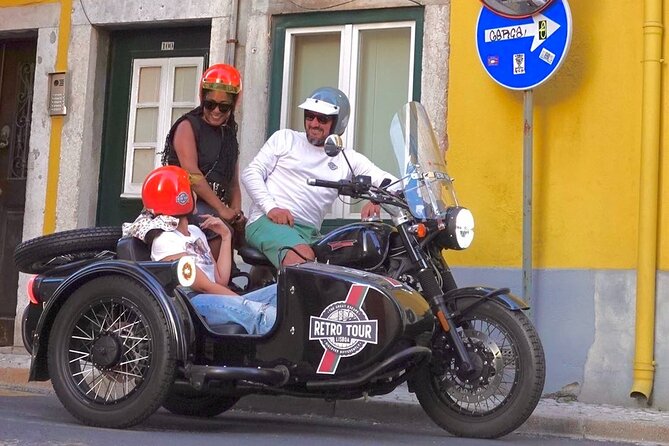
I would recommend it most to a couple or pair of friends who want a private outing and enjoy the novelty of the vehicle. It suits people who have already seen some of central Lisbon and want an efficient way to reach the Cristo Rei side of the river.
It is also a good fit if you like history in compact portions. The route touches independence, the earthquake, archaeology, Lisbon’s water supply, the dictatorship, the 1974 revolution, postwar religious symbolism, and the construction of the bridge. You will not study any one subject for long, but you will see how many periods overlap in a small area.
Photographers should like the format. The ride includes Rua da Bica, the bridge, Cristo Rei, and the view at Casa da Cerca, with the chance to stop for photographs. Ask at the beginning if there is a particular view or neighborhood you want to prioritize.
I would hesitate if your budget is tight, you dislike motorcycles, or you want long visits inside museums and monuments. The route is fast by design, and the price reflects private transport rather than a long admission-based tour.
You can cancel for a full refund up to 24 hours before the local start time. Changes made inside that window are not accepted, and late cancellations are not refunded. Since the ride needs good weather, keep that rule in mind when arranging the rest of your day.
Should you book it?
Book this tour if you want a private, flexible way to cross Lisbon and the Tagus in a short window. The strongest reasons are the sidecar itself, the easy trip to Cristo Rei, the chance to personalize photo stops, and the unusually broad mix of history packed into two hours.
Skip it if you are seeking the lowest-cost route to the statue or prefer a sheltered vehicle. For the right pair, the $360.23 fee buys more than transport. It buys a relaxed guide, a memorable way to see the city, and a fast change of scene from Rua da Bica to the south bank and back.
FAQ
How long does the Lisbon El Cristo-Rei sidecar tour last?
The tour lasts approximately two hours.
How much does the tour cost?
The price is $360.23 per group, for up to two people.
Is this a private tour?
Yes. Only your group participates in the activity.
Where does the tour start?
The meeting point is R. Garrett 88, 1200-204 Lisboa, Portugal.
Where does the tour finish?
The tour ends at Praça do Comércio, 1100-148 Lisboa, Portugal. Drop-off in central Lisbon or at the starting point is also offered.
Is pickup available?
Yes. Pickup is offered.
What equipment is included?
The tour includes a helmet, gloves, and goggles. The motorcycles also have phone chargers.
Is admission to the Cristo Rei stop included?
Yes. Admission to the Sanctuary of Christ the King is included.
What happens if the weather is poor?
The experience requires good weather. If it is canceled because of poor weather, you can choose another date or receive a full refund.
Just added around Portugal
- Private Tour of Piaggio Ape Calesino★ 5.0 · 2 reviews
- Lisbon – Private Vintage Sidecar Tour to Sesimbra’s Coast★ 5.0 · 13 reviews
- Private Sidecar Sunset & Drinks!★ 5.0 · 16 reviews
- Lisbon: Private Experience Motorcycle Sidecar Tour★ 5.0 · 14 reviews
- Lisbon by Fiat 500 Jolly convertible!!★ 5.0 · 4 reviews
- Private Vespa West Tour-Seixal,São Vicente,Porto Moniz(4hr)★ 5.0 · 4 reviews
- Private Vespa Tour Nun´s Valley,Câmara Lobos,CaboGirão(4hrs)★ 5.0 · 6 reviews
- Porto Private Sidecar Tour★ 5.0 · 18 reviews
Lisbon Vespa Tours, compared.


Lisbon Half-Day Handpicked – Private Vintage Sidecar Experience
Read our review →

Browse the lists this tour appears in