
REVIEW · ITALY
Panoramic Tour of Brindisi in Ape Calessino
Brindisi packs Roman roads, a working port, medieval churches, and seafront views into a compact center. This one-hour panoramic ride gives you a quick look at the city without asking you to walk every street under the Apulian sun. The route moves from the harbor to the old center, with short stops at the places that best explain Brindisi.
I especially like the chance to see the Roman columns and port together, since they connect the city’s sea traffic with the ancient Via Appia. The stop at San Giovanni al Sepolcro is another strong point: its round shape and Jerusalem connection make it unlike the usual Italian church visit.
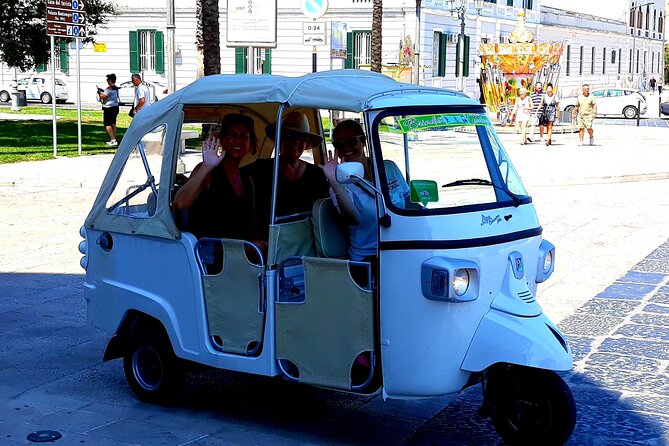
The main caution is that the vehicle may not always match the Ape Calessino shown in the promotional material. One booking was changed to a golf cart, and the English spoken by the guide was difficult to understand. An audio narration in English has also been used, so confirm the current setup before you pay.
Key points to know before booking
- Brindisi in one compact loop: See the tourist port, old center, cathedral, Roman columns, and Roman ruins in about an hour.
- The port sets the scene: Look across the water toward the Monument to the Italian Sailor and learn why Brindisi mattered to Rome and maritime trade.
- San Giovanni al Sepolcro is the standout church stop: You get time to enter the circular temple and its interior garden.
- Short stops mean efficient sightseeing: Most visits last between five and ten minutes, so this is an overview rather than a long guided walk.
- Vehicle and language need checking: The advertised Ape Calessino may be replaced by a golf cart, and the spoken English may vary.
- Private format adds flexibility: Only your group participates, with pickup offered and mobile ticketing available.
Why this ride works well in Brindisi
Brindisi is easy to underestimate. Many people use it as a gateway to Puglia, then move on to Lecce, Ostuni, or Alberobello. Yet the city has a clear story of its own. Rome used it as the end point of the Via Appia, medieval pilgrims passed through on the way to the Holy Land, and the port still shapes daily life.
I like this ride because it gives you that story quickly. You are not simply circling monuments for photographs. The route links the harbor, Roman remains, religious buildings, and later civic architecture. That makes the tour useful on a first visit, especially if you want to decide where to return on foot.
The private format matters too. Your group is the only group on the vehicle, so you are not joining a large sightseeing convoy. The stated price is $127, which is not a low-cost way to spend an hour if you are traveling alone. For a private group, though, the value improves because the cost buys a dedicated ride rather than a seat on a crowded bus.
The tour is short enough to fit before a meal, after arriving in town, or during a brief stop. At the same time, one hour leaves little room for delays. The visit to each sight is tightly timed, and the route is designed to show you a lot rather than give you a long lesson at any one monument.
More Vespa Countryside Tours in Italy
- Florence Vespa Tour: Tuscan Hills and Italian Cuisine
★ 5.0 · 4,019 reviews - Self-Drive Vintage Fiat 500 Tour from Florence: Tuscan Hills and Italian Cuisine
★ 5.0 · 719 reviews - From Florence: Tuscan Countryside Vespa Tour with Tastings
★ 4.9 · 701 reviews
Starting beside Brindisi’s tourist port
The opening section takes you through the internal tourist port. This is more than a scenic warm-up. Brindisi’s port explains why the city has mattered for centuries, linking the Adriatic to trade, military movement, and journeys toward the eastern Mediterranean.
You will also see the city waterfront from the vehicle. Across the water, the Monument to the Italian Sailor provides a large, unmistakable point of reference. The ride gives you a sense of how the port and historic center face each other, which can be hard to grasp when you are walking among narrow streets.
The port is also where the Roman connection begins. Brindisi was the terminal point of the ancient Via Appia, the road that connected Rome with southeastern Italy. The two Roman columns near the waterfront are the visual marker of that connection, and they become more meaningful once you have seen the harbor they once helped define.
Because this is a panoramic portion, do not expect a long stop at every waterfront view. Keep your camera ready, and listen closely if narration is provided. The vehicle format is best for getting your bearings, not for studying inscriptions or architectural details from a distance.
A brief look at the Fountain of the Empire
The first formal stop is the Fountain of the Empire at the foot of Piazza Santa Teresa. The stop lasts about two minutes, and admission is included.
The fountain was dedicated in 1940 to Benito Mussolini. That political background is important. It places the monument within Italy’s Fascist period and gives you a reminder that Brindisi’s public spaces reflect modern political history as well as ancient and medieval heritage.
Two minutes is enough for a quick look and a photograph, but not for a detailed explanation. I would treat this as a visual pause between the port and the old center. If you want to understand the monument in depth, you will need to ask questions or return independently.
Its location near Piazza Santa Teresa also prepares you for the next part of the ride, where civic buildings, churches, and war memorials appear close together. The route does not present Brindisi as a single-period museum. Instead, it moves through layers of the city.
Inside the circular Temple of San Giovanni al Sepolcro
San Giovanni al Sepolcro is one of the most unusual stops. The small church is circular, and its shape is linked to the Anastasis rotunda in Jerusalem. That connection reflects Brindisi’s role in religious travel toward the Holy Land.
You have about ten minutes here, with admission included. Unlike the quick fountain stop, this is enough time to enter the temple and see the interior garden. Inside, look for surviving frescoes showing saints and sacred scenes.
The round plan gives the building a different feel from the long nave of a cathedral. It also helps explain why Brindisi attracted pilgrims and religious institutions. The church is not merely old; its form and decoration point to a wider Mediterranean connection.
Ten minutes remains a short visit. You may have time to look around and take in the main details, but you should not expect an unhurried architectural study. If religious art is a major interest, use the tour as an introduction and return later if opening hours permit. For most people, this is likely to be one of the most memorable stops because the building is compact, distinctive, and closely tied to Brindisi’s role as a port of departure.
More Ape Calessino Tours in Italy:
- Private Tour of Taranto aboard an Ape Calessino
★ 5.0 · 230 reviews - Ape Tour Matera – Panoramic tour in ape calessino
★ 5.0 · 176 reviews - Ape Calessino Tour Sassi of Matera “Standard”
★ 4.5 · 159 reviews - Ape Calessino Tour nei Sassi di Matera
★ 5.0 · 154 reviews
Brindisi Cathedral and its layered interior
The route then reaches the Pontificia Basilica Cattedrale, also called the Basilica of San Giovanni Battista. The first stone was laid by Pope Urban II in 1089, giving the cathedral a direct connection to the religious world of the medieval period.
The cathedral complex includes the bell tower, bishop’s palace, and seminary building. Together, these structures help you read the area as a religious center rather than a single isolated church.
Inside, the details span several centuries. You may see fragments of the 1178 mosaic floor, a wooden choir from 1594 made by local carvers, a sixteenth-century baptismal font, and paintings from different periods. A chapel is dedicated to the relics of San Teodoro, one of Brindisi’s patron saints alongside San Lorenzo.
The scheduled stop lasts about ten minutes. That is enough to see the principal features if the church is open and the pace remains steady. It is not enough to examine every painting or understand each phase of rebuilding. Still, I like the stop because it gives you a compact lesson in how Italian cathedrals change over time. Medieval floors, Renaissance furnishings, later paintings, and the surrounding ecclesiastical buildings all share the same setting.
Keep in mind that religious sites can have access rules or interruptions. The supplied information does not promise a particular guide presentation inside the cathedral, so consider the visit a structured look rather than a full art-history tour.
The Roman columns and the view from Scalinata Virgiliana
The Colonne Terminali della Via Appia are the symbolic heart of this route. They mark the ancient road’s traditional endpoint and connect Brindisi directly to Rome.
The stop lasts about five minutes. From the top of the Scalinata Virgiliana, you can look over the sea and the tourist port. This is one of the clearest moments in the tour because the view and the historical explanation reinforce each other. You see the water that made Brindisi important, then look toward the markers of the road that brought people and goods from Rome.
The short timing is sensible for a panoramic tour, but it does limit what you can do. You will have time for the view and photographs, not a long examination of the columns. If you are walking independently later, this is a place worth revisiting at a slower pace.
The stop also helps put the city into a larger frame. Brindisi was not a remote endpoint in ancient Italy. It was a meeting place between inland roads and maritime routes. That is the kind of context a quick ride can deliver well.
Piazza Santa Teresa and the war memorial
As the vehicle continues through Piazza Santa Teresa, you get a glimpse of Brindisi’s Baroque character and the former Theresian convent. The square also contains a war memorial created in the 1930s by Brindisi artist Edgardo Simone.
The memorial honors about 500 people from Brindisi who died in the First World War. This is a brief passing point rather than a formal stop with a listed visit time, but it adds a modern civic layer to the route.
I appreciate this part because it keeps the tour from becoming a procession of ancient ruins. Brindisi’s identity includes local memory, public art, and the losses recorded in its squares. You may only have a moment to look, so pay attention as you pass through the piazza.
Palazzo Granafei Nervegna and a Roman capital
The sixteenth-century Palazzo Granafei Nervegna brings the route into Renaissance and Baroque Brindisi. Its façade includes Baroque touches, especially in the carved stone balconies.
The stop lasts about five minutes, with admission included. A particularly useful detail is the original capital from the Roman columns, which you can see up close. That gives you a closer look at an ancient architectural element than the waterfront stop allows.
This is a good example of the tour’s method. Instead of placing every Roman object in an archaeological museum, it shows how ancient pieces appear within the later city. The palace also helps you notice the change from medieval religious buildings to grand civic architecture.
Five minutes is enough for a quick look at the façade and capital. If you enjoy architectural details, you will probably wish for more time, but the stop works well within a one-hour route.
Roman streets beneath San Pietro degli Schiavoni
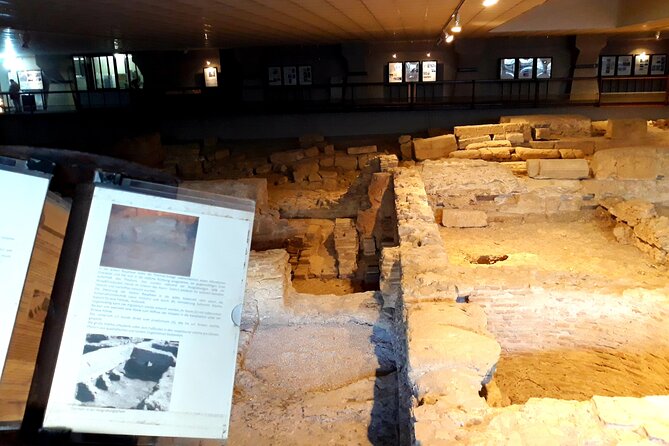
The final major stop is the archaeological area of San Pietro degli Schiavoni. Here you can see part of the ancient Roman city, including the remains of a neighborhood and identifiable houses, or domus, with mosaic floors.
The interior route through the excavations lasts about ten minutes. This is valuable because the ruins are not presented as a single isolated object. You get a sense of an actual urban district, with domestic spaces and street remains that show how people lived.
For me, this stop gives the Roman story more substance. The columns show the road’s endpoint, while San Pietro degli Schiavoni shows the city behind that endpoint. Together, the two locations explain both movement into Brindisi and life within it.
Ten minutes is a practical compromise. You can walk through the excavated area and recognize the mosaics, but you may not have time to study every feature. Wear sensible shoes if you plan to continue exploring on foot afterward, although most participants can take part in the tour according to the supplied information.
The Ape Calessino question
The classic Ape Calessino is part of the appeal. These small Italian three-wheelers make a city ride feel more personal and old-fashioned than a standard bus. The open or compact format should also give you a closer view of streets and façades.
But you should confirm the vehicle before booking. One booking used a golf cart instead, and the change was communicated in advance. A golf cart can still cover the route, but it is not the same experience as the vintage tricycle shown in the tour description.
Language is another point to check. An English audio narration has been used and can add useful context, especially during the quick panoramic sections. At least one experience had a guide whose spoken English was hard to understand. Since the tour is only about an hour, unclear commentary matters more than it would on a half-day outing.
No guide names are provided, so I would not book this expecting a particular person. Ask the operator whether your departure will use live English commentary, an audio system, or another arrangement.
Timing, price, and who gets the best value
At $127, this is best judged as a private orientation tour, not as cheap transportation. The route covers many important sights in about an hour, and admission is included at the scheduled stops. Pickup is offered, and the mobile ticket is convenient for a short visit.
The value is strongest for a group that wants a dedicated vehicle and a fast overview. It also suits anyone who finds extended walking difficult, since the route brings you close to several landmarks. Service animals are allowed, and the experience is near public transportation.
The value is weaker if you already know Brindisi well or prefer to spend ten or twenty minutes inside each monument. You can expect a brisk pace, with stops of two, five, or ten minutes. This is a survey of the city, not a substitute for a full walking tour or museum visit.
Free cancellation is available if you cancel at least 24 hours before the start time. Changes or cancellations inside that window are not refunded. The experience depends on good weather and a minimum number of participants, though if the operator cancels for either reason, you are offered another date or experience, or a full refund.
Should you book the Brindisi ride?
I would book this if you have only a short time in Brindisi, want a private overview, or prefer a ride to a demanding walking route. The strongest parts are the port views, San Giovanni al Sepolcro, the Roman columns, and the excavations at San Pietro degli Schiavoni.
I would pause before booking if the exact Ape Calessino vehicle is essential to you or if clear live English guiding is non-negotiable. Confirm both points first. Also remember that the one-hour format favors breadth over detail.
For a first look at Brindisi, the ride makes sense. It shows you why the port mattered, where the Via Appia ended, how pilgrims shaped the city, and what remains of Roman daily life. Just treat it as your map for further exploration, not the whole Brindisi experience.
FAQ
How long is the Panoramic Tour of Brindisi in Ape Calessino?
The tour lasts approximately one hour.
Is hotel or location pickup available?
Pickup is offered, though the supplied information does not specify every pickup location.
Is the tour private?
Yes. Only your group participates in the activity.
Are admission tickets included?
Admission is included for the listed stops at the Fountain of the Empire, Temple of San Giovanni al Sepolcro, Brindisi Cathedral, Palazzo Granafei Nervegna, and San Pietro degli Schiavoni.
Is the tour available in English?
An English audio narration has been used on the tour. The quality and format of spoken English may vary, so confirm the current arrangement before booking.
What happens if bad weather cancels the tour?
If poor weather causes cancellation, you are offered a different date or a full refund. The same applies if the minimum number of participants is not met.
Just added around Italy
- Vintage Ape Calessino: Polignano a Mare Tours★ 4.9 · 8 reviews
- Volterra: Aperivintage aperitif in vineyard whit a Fiat 500★ 5.0 · 7 reviews
- Vespa Tour with Professional Photographer★ 4.9 · 9 reviews
- Rome: Vespa Tour with Gelato and Photos★ 4.9 · 7 reviews
- Vespa tour with Professional Photoshoot★ 4.8 · 22 reviews
- Food tour & Vespa tour & Photo tour! All included★ 5.0 · 2 reviews
- Vespa Tour – Explore Ancient Rome★ 5.0 · 5 reviews
- Vespa Sidecar Tour: Highlights of Rome★ 4.7 · 10 reviews
Italy Vespa Tours, compared.
Florence Vespa Tour: Tuscan Hills and Italian Cuisine
Read our review →

Rome Morning Vespa Sidecar Tour in Rome with Cappuccino
Read our review →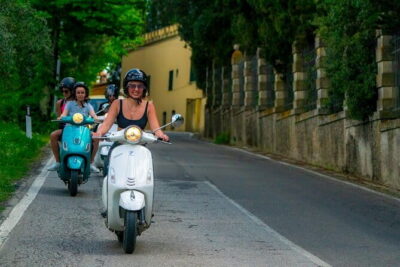
Chianti Vespa Tour with Lunch from Florence & E-car Option
Read our review →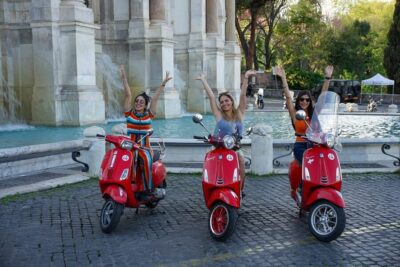
Explore the City by Vespa with an Optional Photoshoot
Read our review →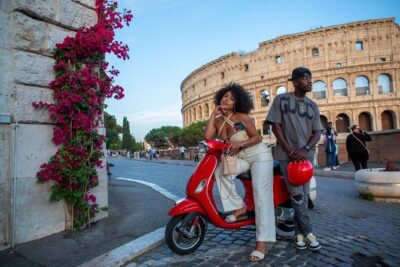
Rome Vespa Scooter Tour with Professional Photographer
Read our review →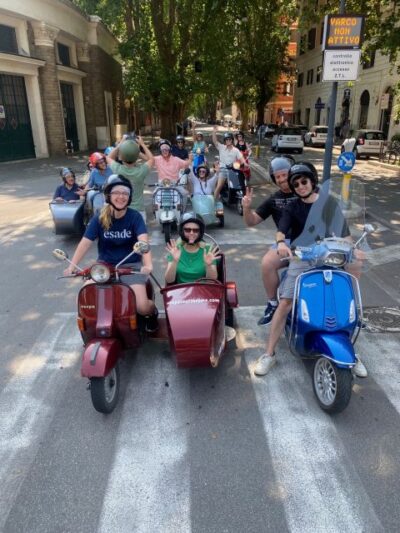
Highlights Vespa Sidecar Tour with Coffee and Gelato
Read our review →
Browse the lists this tour appears in