
REVIEW · ROME
Vespa Tour Highlights of Rome
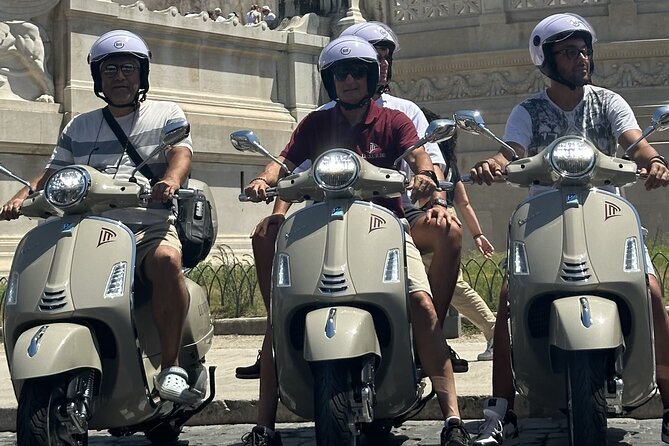
Rome is easier to understand when you see how its ancient ruins, grand churches, narrow lanes, and lively squares fit together. This three-hour Vespa tour covers a remarkable amount of ground, with stops at the Trevi Fountain, Pantheon, Colosseum, Vatican City, Trastevere, and several less obvious corners of the city.
I like the maximum group size of three, which should make the ride feel more personal than a large bus tour. I also like that you ride as a passenger with a company driver, so you can watch the streets and landmarks instead of worrying about traffic. The main concern is reliability: one reported outing involved a long wait in the rain, poor communication, and a driver who did not speak English.
Key points to know before booking
- Three hours and 13 major stops: You get a fast, broad introduction to central Rome rather than long visits inside individual monuments.
- You do not drive the Vespa: A company employee handles the scooter, while you ride as a passenger.
- Very small group: The maximum is three people, a useful feature for couples or a small family.
- Several major sights are photo stops only: Admission to the Pantheon, Vatican City sites, and Colosseum is not included.
- Useful extras are included: You receive a helmet, interactive reading materials, professional pictures, and a live interactive guide.
- Weather matters: Poor weather can lead to a rescheduled tour or a full refund.
Why a Vespa is useful in central Rome
Rome’s best-known sights are not far apart on a map, but walking between them can take time. A Vespa gives you a quick way to connect the historic center, the Forum area, the Colosseum, the Vatican, and Trastevere in one outing.
The ride is also a practical sightseeing format. You are not sealed inside a vehicle, and you can see the streets between the landmarks. That matters in Rome, where the route itself often reveals as much as the destination.
This is not a self-drive rental. The driver is an employee of the company, and you ride behind that driver. That removes the challenge of navigating Roman traffic, but it also means you should book this only if you are comfortable being a passenger on a scooter.
The group limit of three is one of the strongest features. You can ask questions more easily, and the guide has a better chance of adjusting the pace to your interests. At the same time, the small group does not guarantee a private tour in the strict sense, so check the booking details if exclusive use matters to you.
More Vespa City Highlights Tours in Rome:
- Rome: Highlights Vespa Sidecar Tour with Coffee and Gelato
★ 4.9 · 747 reviews - Rome Afternoon Sightseeing Vespa Sidecar Tour with Gourmet Gelato
★ 5.0 · 692 reviews - Rome: Vespa Tour with Photo services Small‑Group Highlights
★ 5.0 · 483 reviews
Starting at Largo Carlo Goldoni
The meeting point is Largo Carlo Goldoni, an elegant square near Rome’s high-end shopping streets. It is a useful starting place because you begin in the heart of the city, surrounded by handsome buildings, polished storefronts, and plenty of urban energy.
The square is dedicated to Carlo Goldoni, the Venetian playwright. You may not spend much time here before setting off, but it gives you an immediate sense of Rome’s mix of old streets and modern city life.
The activity ends back at the same meeting point. It is near public transportation, which makes the start and finish easier to manage, especially if you are staying in central Rome.
Trevi Fountain and the Pantheon
The first major stop is the Fontana di Trevi. This is Rome’s grandest Baroque fountain, packed with carved figures and theatrical stonework. You have about 15 minutes here, enough to see the fountain, take pictures, and make the traditional coin toss if you wish.
The coin legend says that throwing a coin into the fountain ensures a return to Rome. The practical point is that Trevi is usually crowded, so a short stop is best treated as a quick look rather than quiet contemplation.
Next comes the Pantheon, another 15-minute stop. Its huge dome and central opening, called an oculus, remain the building’s most striking features. The structure began as a Roman temple dedicated to all the gods and still gives you a direct sense of ancient engineering.
Admission to the Pantheon is not included. The tour schedule allows only a short stop, so you should not expect time for a detailed interior visit unless the guide’s timing permits it. If entering the building is important to you, ask in advance how admission works and whether the stop is intended for an exterior view or a quick visit inside.
Piazza Navona and Piazza Venezia
Piazza Navona is one of Rome’s most attractive public squares. Its long shape follows the footprint of an ancient stadium, while the Baroque fountains and surrounding cafés give it a more polished, artistic feel.
The central Fontana dei Quattro Fiumi, or Fountain of the Four Rivers, is the main sight. You have 15 minutes here, which should be enough for a walk around the square and a few photographs. I would not plan a full café break during this stop because the schedule moves quickly.
Piazza Venezia offers a sharp change in mood. It is a major traffic junction dominated by the Altare della Patria, the huge white monument often associated with modern Italy. The square can feel busy and noisy, but it is also a useful place to see how Rome’s ancient center connects with its modern streets.
Again, the stop lasts about 15 minutes and admission is free. This is a viewing and orientation stop, not a museum visit.
More Vespa Tours in Rome:
- Vespa Sidecar Tour By Night with Pickup
★ 5.0 · 1,803 reviews - Rome Morning Vespa Sidecar Tour in Rome with Cappuccino
★ 5.0 · 1,771 reviews - Rome: Explore the City by Vespa with an Optional Photoshoot
★ 5.0 · 1,103 reviews - Rome Vespa Scooter Tour with Professional Photographer
★ 5.0 · 857 reviews
The Jewish Ghetto and Teatro di Marcello
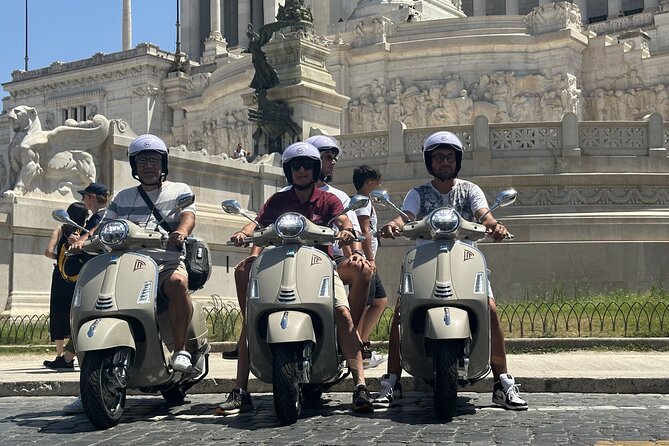
The Ghetto Ebraico offers a more intimate side of Rome. Its narrow streets and Jewish cultural traditions provide a break from the monumental scale of the fountains, forums, and churches. You may also find traditional Jewish-Roman food in the area, though the short schedule is not designed around a full meal.
The neighborhood carries centuries of Jewish history in Rome, but the tour gives you only a brief introduction. Think of it as a chance to note the area and return later if its streets and restaurants appeal to you.
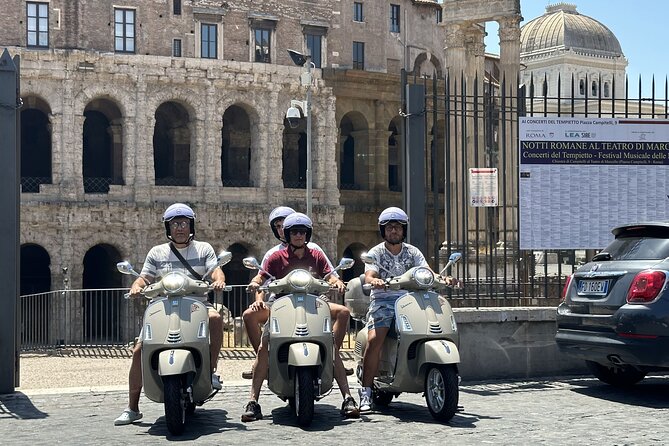
Nearby, Teatro di Marcello provides one of the most interesting ancient sights on the route. This theater predates the Colosseum and is still partly used today. Its surviving arches show how Roman buildings were often adapted over time rather than simply abandoned.
The theater is especially good for a quick photo stop because you can appreciate its scale without committing to a long museum visit. Admission is free, and the stop is scheduled for about 15 minutes.
Ancient markets and the Imperial Forums
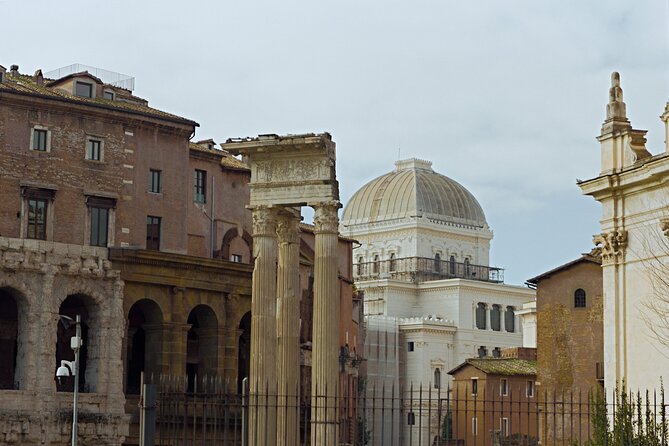
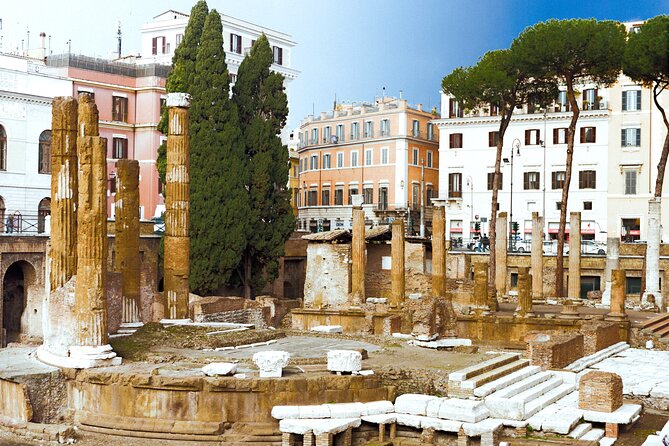
Via del Foro Piscario takes you toward the remains of an ancient Roman market. The ruins offer a glimpse of everyday commerce, a useful counterpoint to Rome’s emperors, temples, and triumphal monuments.
You will not receive a long archaeological visit here. The value is in seeing how ordinary trade formed part of the ancient city. A live guide and interactive reading materials should help give the ruins more context than a quick look on your own.
The route then reaches Via dei Fori Imperiali, one of the strongest stretches for seeing the scale of ancient Rome. Ruins and monuments line the broad avenue, and the surrounding archaeological area makes it easier to picture the imperial center as a functioning city.
This stop is still brief, so you should not expect to explore every forum. The Vespa format works well here because it lets you see several major sections of the archaeological area without spending the entire afternoon on foot.
Trastevere for a more local feel
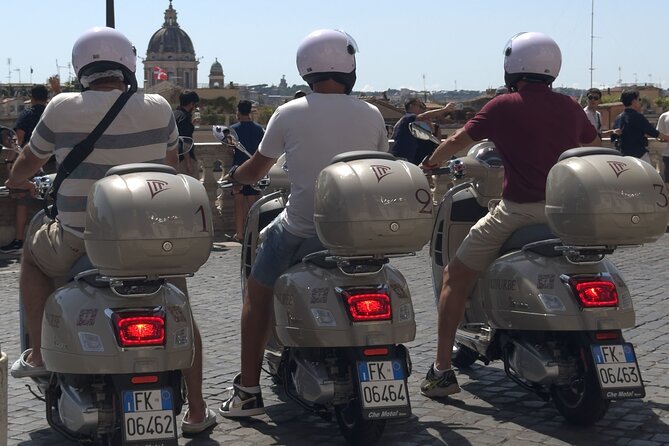
Trastevere is one of the most appealing neighborhoods on the route. Its narrow streets, trattorias, and evening activity give you a different view of Rome from the formal spaces around the monuments.
The stop is useful for orientation. You can see where Romans go for food and nightlife, and you may decide to return later for a slower meal. The tour does not include food, and 15 minutes is not enough to sample the neighborhood properly, so treat this as a preview rather than a dining stop.
I especially like having Trastevere included because the tour would otherwise focus almost entirely on famous monuments. Here, the emphasis shifts to streets, restaurants, and the feel of a lived-in neighborhood.
Vatican City and St. Peter’s Basilica
The Vatican City stop brings you to St. Peter’s Basilica, the center of the Catholic Church and one of the most important Renaissance buildings in Europe. The scale of the basilica and the surrounding area can be impressive even if you are seeing them only from outside.
Admission to St. Peter’s Basilica and Vatican attractions is not included. The tour also does not provide a dedicated Vatican Museums visit. If your main goal is the Sistine Chapel, the Vatican Museums, or a close look inside St. Peter’s, you should book separate admission and allow several hours.
The Vespa tour is still useful here because it gives you a quick look at the area without using your full sightseeing day. You can decide afterward if you want to return for a longer visit.
The Colosseum and Circus Maximus
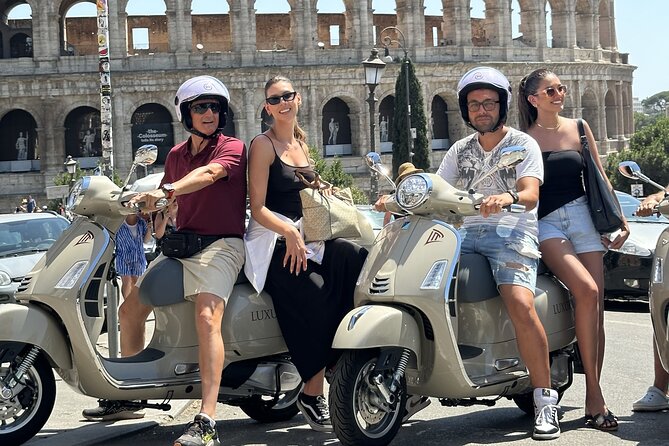
The Colosseum is the tour’s most instantly recognizable stop. This ancient amphitheater once hosted gladiatorial contests and public spectacles, and its surviving structure remains one of Rome’s clearest links to the Roman world.
Admission is not included, and the planned stop lasts about 15 minutes. That means you should expect an exterior view and photographs rather than a full exploration of the interior, underground levels, or upper tiers. If entering the Colosseum matters to you, plan a separate timed visit.
The final major area is Circus Maximus, once a vast stadium for chariot races. Today, it is an open public park, and the broad space makes it easier to imagine the scale of Roman entertainment.
The stop adds a useful ending to the ancient-Rome portion of the tour. After seeing the Colosseum’s stone structure, Circus Maximus shows you the size of the larger public spaces that once filled the city.
What the three-hour schedule really means
The tour lists roughly 15 minutes at each stop. With 13 listed locations, that is a fast pace, and travel time must fit into the three-hour window.
You should think of this as a city overview by scooter, not a series of in-depth monument visits. It works best during your first days in Rome, when you want to learn the layout and mark places for later visits.
The live guide, interactive reading materials, and professional pictures add value to the short stops. You can focus on looking around rather than taking every photograph yourself. Still, the quality of the experience depends heavily on clear communication between guide and passenger.
English is the advertised language. One reported outing involved a driver named Massimo who did not speak English, and the group did not receive the expected guided experience. That appears to be a serious service failure rather than a normal feature, but it is worth confirming the language and guide arrangements before setting off.
Price, included extras, and practical value
At $217.69 per person, this is not a cheap way to see Rome. The price can make sense if you value a very small group, a professional driver, a live guide, photographs, and the ability to cover many districts in three hours.
It offers less value if you want interior visits. Admission to the Pantheon, Vatican City attractions, and Colosseum is not included, and the schedule does not leave much time for them anyway. You are paying mainly for the ride, route, guiding, and convenience.
The helmet is included, as are interactive reading materials and professional pictures. Those extras are useful, but I would not book the tour for the photos alone. The main benefit is the compact introduction to Rome’s major sights and neighborhoods.
Most people can participate, and the meeting point is near public transportation. The activity requires good weather, so keep some flexibility in your Rome schedule. If poor weather causes cancellation, you can receive a different date or a full refund.
Free cancellation is available if you cancel at least 24 hours before the start time. Changes or cancellations inside that window are not refunded.
Who should book this Vespa tour?
I would consider it a good fit for you if:
- You have only a short time in Rome and want a broad first look.
- You enjoy seeing a city from the street rather than from a coach.
- You are comfortable riding as a passenger on a Vespa.
- You prefer a group of three or fewer.
- You want to identify places to revisit on foot.
- You are happy with exterior views and short stops.
I would choose another format if you want long museum visits, detailed archaeological explanation, or guaranteed time inside the Colosseum and Vatican Museums. Families or groups larger than three should also check carefully, since the stated maximum is three participants.
Should you book it?
Book this tour if your priority is seeing Rome’s major sights quickly, with the fun of a Vespa and the ease of a professional driver. The route is broad and well chosen, and the small group can make the experience feel more personal.
Before paying, confirm the English-speaking guide, pickup details, and what happens if the driver is delayed. The long-wait account shows why communication matters. If the operator confirms those details and the weather looks good, this can be a memorable way to get your bearings in Rome. If you want to enter the monuments, treat this as a preview and reserve separate visits.
FAQ
How long does the Vespa tour last?
The tour lasts approximately three hours.
Where does the tour begin and end?
It begins at Largo Carlo Goldoni in Rome and ends back at the same meeting point.
Do I drive the Vespa?
No. The driver is directly employed by the company, and customers ride as passengers.
How many people can join the tour?
The maximum group size is three people.
Is the tour offered in English?
Yes. The activity is offered in English.
Are admission tickets included?
Admission is not included for the Pantheon, Vatican City attractions, or the Colosseum. The listed stops at the Trevi Fountain, Piazza Navona, Piazza Venezia, the Jewish Ghetto, Teatro di Marcello, Via del Foro Piscario, Via dei Fori Imperiali, Trastevere, and Circus Maximus are listed without an admission charge.
What is included in the experience?
A helmet, interactive reading materials, professional pictures, and a live interactive guide are included.
What happens if the weather is poor?
If poor weather causes cancellation, you will be offered another date or a full refund. You can also cancel at least 24 hours before the start time for a full refund.
Just added around Rome
- Vespa Tour with Professional Photographer★ 4.9 · 9 reviews
- Rome: Vespa Tour with Gelato and Photos★ 4.9 · 7 reviews
- Vespa tour with Professional Photoshoot★ 4.8 · 22 reviews
- Vespa Sidecar Tour: Highlights of Rome★ 4.7 · 10 reviews
- Food tour & Vespa tour & Photo tour! All included★ 5.0 · 2 reviews
- Vespa Tour – Explore Ancient Rome★ 5.0 · 5 reviews
- Vespa Sidecar Tour : Rome by Night★ 4.1 · 7 reviews
- Vespa Scooter Tour “Rome as a Local”★ 5.0 · 12 reviews
Rome Vespa Tours, compared.
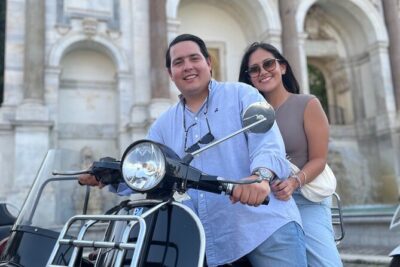

Rome Morning Vespa Sidecar Tour in Rome with Cappuccino
Read our review →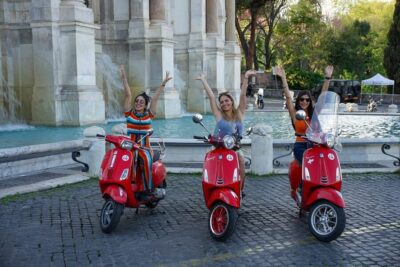
Explore the City by Vespa with an Optional Photoshoot
Read our review →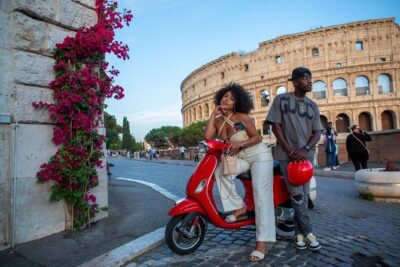
Rome Vespa Scooter Tour with Professional Photographer
Read our review →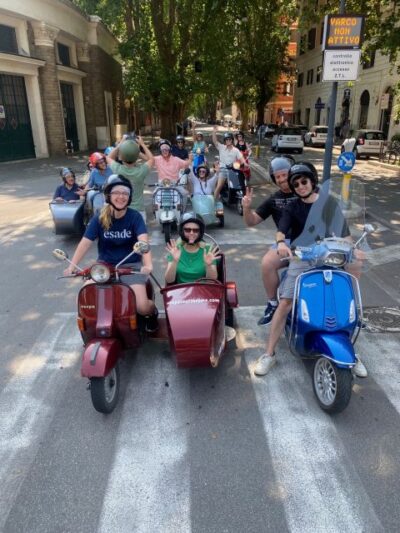
Highlights Vespa Sidecar Tour with Coffee and Gelato
Read our review →
Rome Afternoon Sightseeing Vespa Sidecar Tour with Gourmet Gelato
Read our review →
Browse the lists this tour appears in